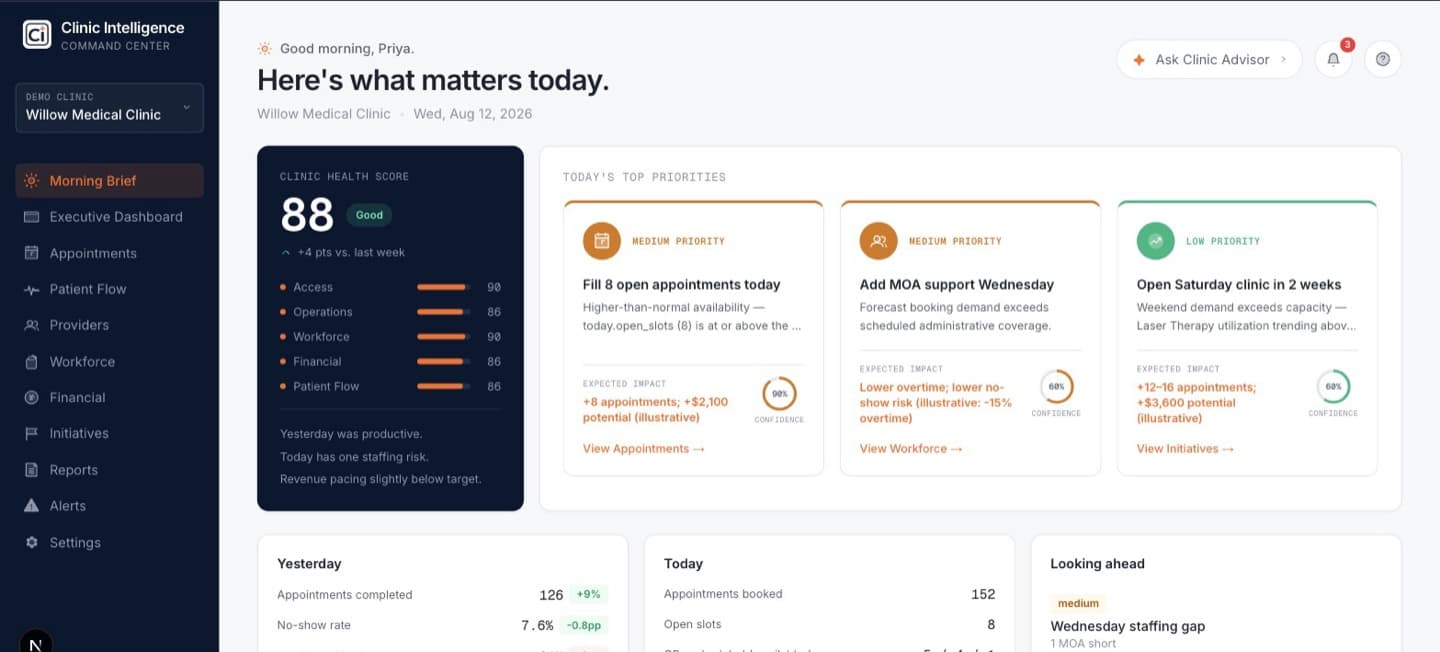
The Operating Intelligence Platform for Modern Clinics
Connect your existing clinical, scheduling, payroll, finance, and booking systems to gain one real-time view of your clinic—and the operational recommendations you need to improve performance.
Healthcare has invested billions in clinical software. Most clinic leaders still run operations on spreadsheets.
Clinic Intelligence is the operating system for community healthcare — connecting the systems primary care, specialist, and allied health clinics already run, without replacing any of them.
Whether you operate one clinic or one hundred, Clinic Intelligence gives leaders one real-time view of how their organization is performing.
Connect. Don't replace.
Average wait time up 12 minutes this week at Uptown
Wednesday coverage gap — 2 providers on PTO, no backfill scheduled
Revenue pacing $18,400 below target this month [Illustrative]
No-show rate rising — Downtown, third week in a row
→ Automated reminder at 48h + 4h for Tue/Thu PM appointments
Expected impact (illustrative): 6–8 slots/week recovered
Nobody has a real-time view of how the clinic is actually running.
Fragmented systems
Managers manually combine data from the EMR (OSCAR, Med Access), scheduling/booking (Jane App, Cortico), payroll (Payworks, Humanity), and finance (QuickBooks) to understand how a clinic — or a group of clinics — is actually performing.
Insight arrives too late
By the time a manual report surfaces a staffing gap or a no-show pattern, the week that mattered is already over.
No group-level view
Multi-site groups have no way to compare location performance without exporting and reconciling data from every clinic separately.
No analyst on staff
Unlike hospitals, community clinics have no dedicated BI or operations-analytics function. The clinic manager is the analyst — on top of running the clinic.
A 5-location allied health group losing an estimated X% of billable capacity to unfilled slots and staffing misalignment — invisible until month-end reconciliation. Replace with a real number from the 90-day validation interviews.
ABC Primary Care Clinic, 4 locations — one Monday morning.
Open Jane App, check bookings across 4 locations one by one
Export scheduling data to Excel
Open Payworks, check hours against schedule
Open QuickBooks, pull last week's revenue by location
Still building the Monday report
Report finally goes out — a week's worth of decisions already missed
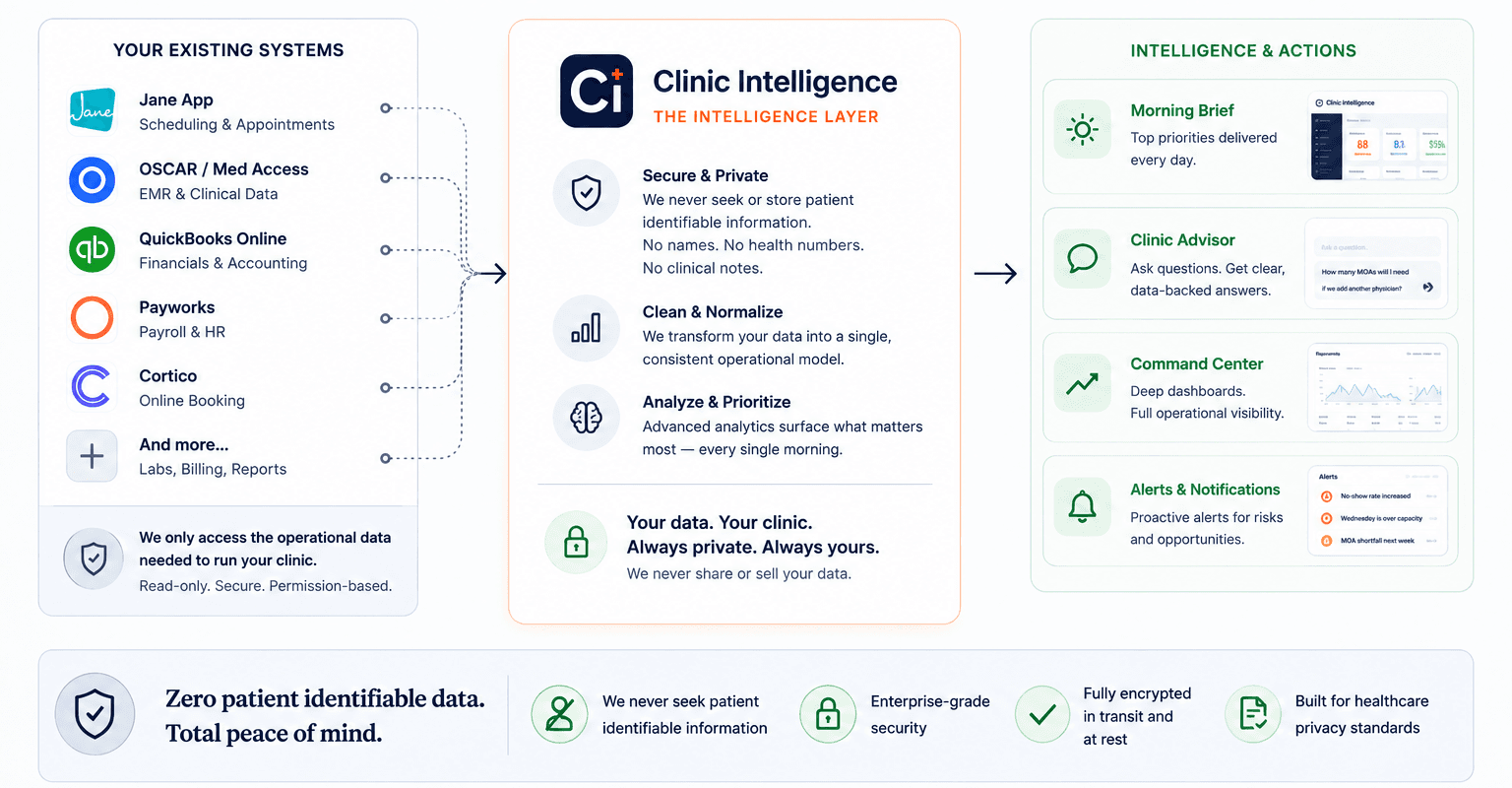
Connect the systems already in place. Surface what changed.
Connect
Read-only integrations starting with modern booking/scheduling platforms (Jane App and similar), expanding to EMR, payroll, and finance sources as the product matures. Every integration pulls operational metadata, not patient records — no names, no PHNs, no clinical notes.
Unify
Normalize provider, appointment, and revenue data into one operational layer across every location in a group.
Surface
Flags what changed and why — a no-show spike, a staffing gap, a utilization drop — before it shows up in month-end numbers.
Act
Ranked, explained recommendations delivered weekly, not buried in a dashboard nobody opens.
The same Monday morning, with Clinic Intelligence running.
Open Clinic Intelligence
Clinic Intelligence flags:
- •No-show rate rising — Downtown
- •Wednesday coverage gap — 2 providers on PTO, no backfill
- •Utilization down 6% vs. last week
- •Revenue pacing $18,400 below target this month [Illustrative]
Done. Decisions made before the first patient walks in.
What a clinic manager sees

The Clinic Intelligence Command Center — Weekly Ops Digest view. Live, interactive demo, not a static mock.
Explore it yourself →What a clinic manager actually asks — not what a dashboard usually answers.
“Why were no-shows so high last week?”
The digest already has the answer queued up every Monday: Downtown's Tue/Thu PM slots underfilled, three weeks running — flagged and explained before month-end, not after.
“What benefit would another RN have on the clinic?”
Recurring Wednesday/Friday coverage gaps get quantified automatically across locations — so a hiring decision comes with a projected dollar impact attached, not a guess.
Privacy by Design
Clinic Intelligence is designed to minimize the use of patient-identifiable information by focusing on operational data.
From the EMR — operational metadata only
Appointment volumes, durations, and types; provider schedules; panel size in aggregate; no-show rates; cancellation patterns; wait times. None of this requires names, personal health numbers, addresses, or clinical notes.
From billing — high-level only
Number of billings, gross amounts, time to submit, rejection rates. Operational, not patient-specific.
If patient-level data is ever needed
For something like continuity-of-care or repeat-no-show analysis — hashed or pseudonymized IDs only, never direct identifiers.
Built for Better Business Outcomes
Clinic Intelligence isn't designed to generate more reports. It's designed to help clinic leaders make better operational decisions that improve financial performance, increase access, and reduce administrative burden. Every recommendation should have a measurable operational impact.
Increase Revenue
Recover missed appointments, improve provider utilization, optimize scheduling, and identify opportunities to increase clinic capacity.
Reduce Costs
Reduce overtime, improve staffing decisions, eliminate manual reporting, and identify operational inefficiencies before they become expensive.
Save Time
Replace hours of manual spreadsheet work with automated operational insights, freeing managers to improve the clinic instead of preparing reports.
Improve Access
Reduce wait times, improve patient flow, lower no-show rates, and help more patients access care using existing resources.
Whether you operate one clinic or one hundred, Clinic Intelligence gives leaders one real-time view of how their organization is performing.
Every recommendation should answer one question: How does this improve the business?
Illustrative Business Impact
While the exact return will vary by clinic, the value of operational intelligence can be measured through improvements such as: recovering additional appointment capacity, reducing no-show rates, improving provider utilization, lowering overtime costs, reducing administrative reporting time, improving room utilization, and earlier identification of operational issues.
All ROI assumptions will be validated during pilot implementations.
What if every recommendation came with an expected impact?
Open one additional Tuesday evening clinic — Downtown.
Expected impact (illustrative): ~42 additional appointments/month · Improved patient access · Reduced wait times · Increased provider utilization.
Confidence: MediumAdjust Wednesday staffing — Downtown.
Expected impact (illustrative): Lower overtime costs · Better room utilization · Improved patient experience.
Confidence: MediumWhy couldn't someone have built this five years ago?
Real APIs, finally
Modern booking platforms like Jane App expose usable APIs — something legacy EMRs never did.
Cloud infrastructure is a commodity
Secure, PHI-compliant infrastructure is a checkbox now, not a multi-year engineering project.
AI got practical
Turning messy operational data into a plain-English recommendation no longer needs a data science team.
Clinics are consolidating
Multi-location groups are becoming the default — and they have no way to see across locations.
Labour is scarcer
Every unfilled slot and staffing gap costs more when providers are harder to hire and replace.
Managers are maxed out
The operational complexity clinics run on has outgrown what one person juggling five systems can track.
The market has EMRs and point tools. Not an operations layer.
| Company | What they actually do | Overlap with Clinic Intelligence |
|---|---|---|
Med Access / PS Suite (TELUS Health) | Clinical EMR — charting, e-prescribing, in-clinic scheduling | Low — we read this data, we don't compete on charting |
OSCAR / OSCAR Pro, WELLSTAR (WELL Health) | Clinical EMR + billing tools (DoctorCare, ClinicAid, PatientServ) across WELL's own 250+ clinic network | Low–Medium — WELL is also a potential channel, and a company to watch if WELLSTAR extends into cross-clinic ops |
CHIME (Chime Technology — independent, not TELUS-owned) | AI-powered clinic orchestration software — staffing/room capacity optimization, hardware + software, integrates with TELUS PS Suite and other EMRs | Highest overlap of anyone on this list — closest existing product to our staffing/utilization wedge. Say this plainly rather than let a partner discover it first. |
Innovaccer / Arcadia | Population-health & value-based-care analytics for large health systems and payers, built on clinical/claims data | Low — different buyer (health-system population health leads), different data (clinical/claims, not scheduling/payroll), different scale entirely |
Microsoft Power BI | General-purpose BI — requires manual data modeling, no healthcare rules, no proactive recommendations | Low — a toolkit, not a product; community clinics rarely have staff to build this themselves |
Where we actually sit: They manage EMRs, population risk, or general-purpose BI. We manage the day-to-day operations of the clinic itself.
One more difference: the EMRs above are built around patient-identifiable charting. Clinic Intelligence isn't — operational metadata only, by design.
Segmented by vertical — allied health is the beachhead.
| Primary Care | Specialists | Allied Health | |
|---|---|---|---|
| Providers (Canada) | ~48,200 family physicians (CIHI, 2024) | ~49,000 specialist physicians (CIHI, 2024) | 23,475 dentists (StatCan, 2021)[Validate] physio/chiro/optometry counts — not yet sourced |
| Common systems | OSCAR, Med Access, Telus PS Suite | Mixed EMR + specialty scheduling tools | Jane App and similar modern SaaS |
| Integration difficulty | High — legacy EMR APIs, heavy PHI compliance | Medium–High | Low — chosen beachhead |
Why allied health first: modern booking platforms like Jane App expose real APIs, multi-location chains are common, and clinical-data sensitivity is lower — weeks to integrate instead of months. Primary care and specialist EMR integration (OSCAR/Med Access) follows once the model is proven and the harder integration work is justified by traction.
Discussion options — not a locked decision.
| Model | Structure | Notes |
|---|---|---|
| Per-location SaaS | Flat monthly fee per clinic location | Predictable, easiest to sell, weakest upside |
| Per-provider seat | Priced per active provider | Scales with group size naturally |
| Outcomes-linked | % of recovered no-show/utilization revenue | Strong land-and-expand hook, harder to price and measure early |
Willingness-to-pay for each is a 90-day validation question, not something to resolve on this page.
The near-term plan is a pilot. The destination is bigger.
The near-term plan is a weekly ops digest for one allied-health pilot group. The destination is bigger: the system community clinics run their operations on — not another dashboard competing for a browser tab, but the layer everything else plugs into.
Worth deciding as a team: how much of this ambition goes on the page today, versus gets earned once there's pilot data behind it.
Phased — proven with one pilot before the next bet.
Validation
- –Interview 20–30 clinic leaders, weighted toward multi-site allied health groups
- –Confirm Jane App / booking-platform API feasibility
- –Map the highest-value pain point per vertical
MVP
- –Weekly Ops Digest live with one allied health pilot group
- –Booking/scheduling data only — no EMR integration required
Staffing layer + expansion
- –Add staffing/scheduling risk alerts
- –Onboard a second allied health group
- –Begin EMR integration feasibility work for primary care
Primary care & specialist expansion
- –EMR integration (OSCAR/Med Access)
- –Financial/billing reconciliation module
- –Cross-clinic benchmarking
- –Complete operational intelligence layer across every connected system
Built by people who have lived the problem.
We've managed clinics, led digital transformation initiatives, and built growing businesses. Clinic Intelligence isn't based on assumptions — it's designed around the real operational challenges clinic leaders face every day.
Complementary strengths across healthcare operations and transformation, digital health and enterprise technology implementation, and investment, business growth and capital allocation.
What's still unresolved.
Allied health first, or primary care first?
Allied health is easier to integrate but less emotionally resonant. Primary care is harder to integrate, but the “6.5M without a doctor” story is a stronger hook.
Which pricing model do we test in the first pilot?
Per-location, per-provider, or outcomes-linked — see the Business Model section. Not resolving this on the page; resolving it with pilot data.
Do we already have clinic relationships to pilot with?
At zero sales cost — or does this require cold outreach from day one?
What's the minimum data-source list for a credible 90-day pilot?
Booking data alone, or booking + payroll?